Couldn’t Be Happier? Rethinking Happiness Through a Disability Inclusion Lens

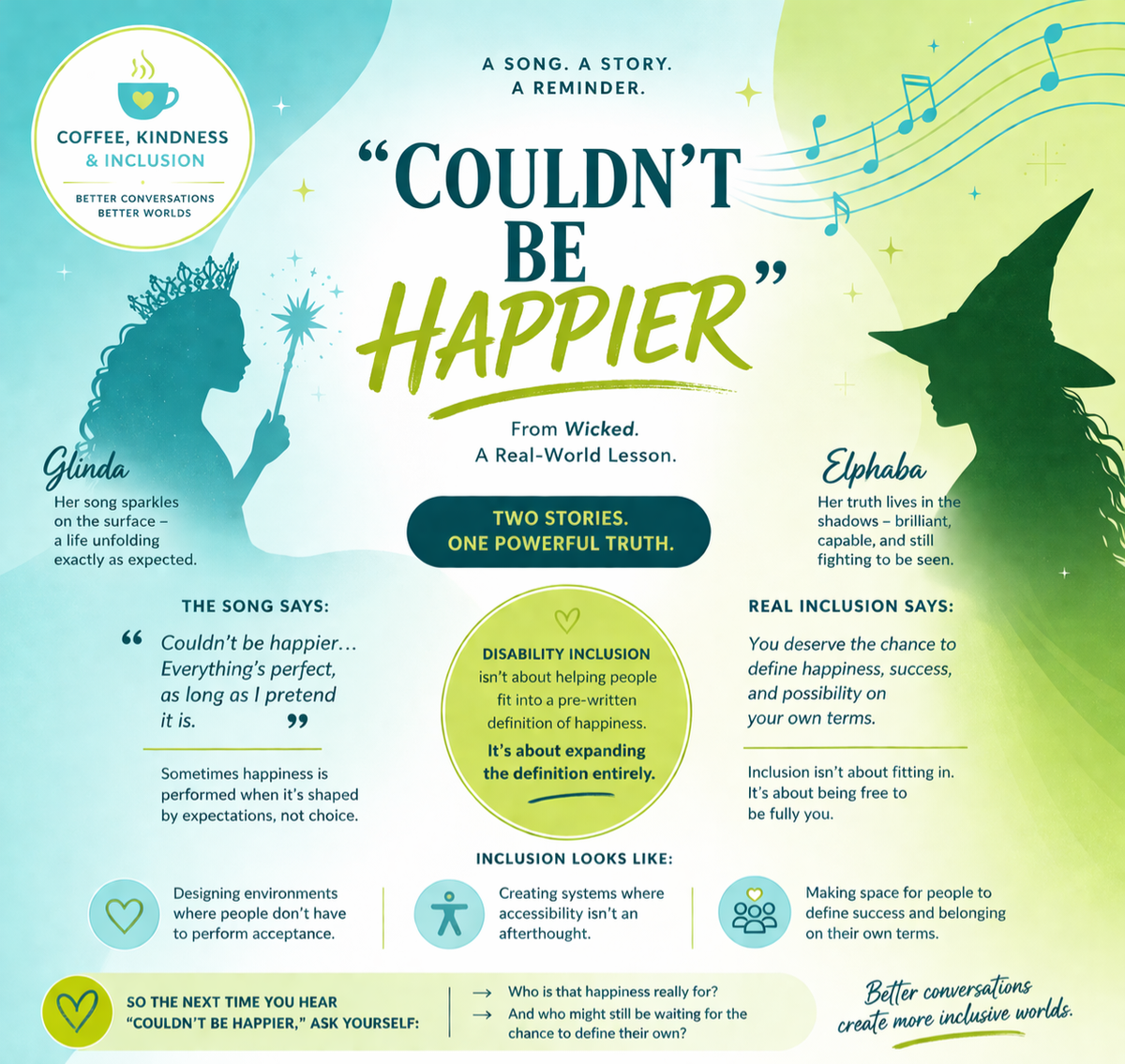
There’s a moment in Wicked where Glinda takes center stage and sings “Couldn’t Be Happier.”
It’s bright. It’s celebratory. It’s everything you’d expect from someone whose life is unfolding exactly as planneOn the surface, it feels like joy.
But if you pause—and really listen—it reveals something more complicated.
Because “Couldn’t Be Happier” isn’t just about happiness.
It’s about performance
The Performance of Happiness 🎶
Glinda’s moment is polished. Perfect. Expected.
She is living the version of success that the world told her to want—and she’s playing that role flawlessly. But beneath the sparkle is a quiet tension: Is this happiness authentic? Or is it assigned? That distinction matters more than we think. Because performance-based happiness doesn’t just live on a Broadway stage. It shows up in our workplaces, our systems, and our everyday interactions—especially for people with disabilities.
When the World Defines Happiness for You 🌎
For many individuals with disabilities, happiness is often framed by others:
“You should just be grateful to be here.” “Isn’t it amazing you can do that?” “This is good enough, right?”
These statements may be well-intentioned—but they carry an underlying message:
Your expectations should be smaller. Your definition of success should be simpler.
It’s a version of “couldn’t be happier” that isn’t fully chosen.
It’s assigned.
And over time, that can quietly shape how people see themselves, their potential, and what they believe they’re allowed to want.
Just Outside the Spotlight: Elphaba’s Reality 🧹
While Glinda shines in the spotlight, Elphaba exists just outside of it.
She is brilliant. Capable. Deeply misunderstood.
And she’s navigating a world that wasn’t built with her in mind.
That contrast is where the real lesson lives.
Because disability inclusion isn’t about celebrating one version of success while ignoring another.
It’s about recognizing that:
Not everyone starts from the same place Not everyone is seen the same way And not everyone has equal access to define their own path
Elphaba’s story reminds us that exclusion often isn’t about ability—it’s about environment.
Expanding the Definition of Inclusion ♿
If we want to move beyond performative happiness, we have to rethink what inclusion actually means.
Disability inclusion is not:
- Lowering the bar
- Offering gratitude in place of opportunity
- Expecting people to adapt to broken systems
Instead, it’s about expanding what’s possible.
It looks like:
- Designing environments where people don’t have to perform acceptance
- Building systems where accessibility is embedded—not added later
- Creating cultures where success is self-defined, not prescribed
Because true inclusion doesn’t ask, “Why aren’t you happy with this?”
It asks, “What do you need to build a life that genuinely fulfills you?” From Performance to Possibility 💡
When we shift from performance to possibility, everything changes.
We move from:
- Compliance → Commitment
- Awareness → Action
- Inclusion as a concept → Inclusion as a lived experience
And most importantly, we create space for people to define happiness on their own terms.
Not the version that’s expected. Not the version that’s convenient.
The version that’s real. A Final Thought 🎬
So the next time you hear “Couldn’t Be Happier,” pause for a moment. Ask yourself:
Who is that happiness really for? Who helped define it? And who might still be waiting for the chance to define their own?
Because inclusion isn’t about helping people fit into the story that already exists.
It’s about making sure everyone has the power to write their own.