Disabled Professions vs. Standard Career Growth
So when you see a disabled professional intentionally accelerating their career—seeking promotions, leadership opportunities, or broader scope earlier—it’s rarely about ego or impatience.

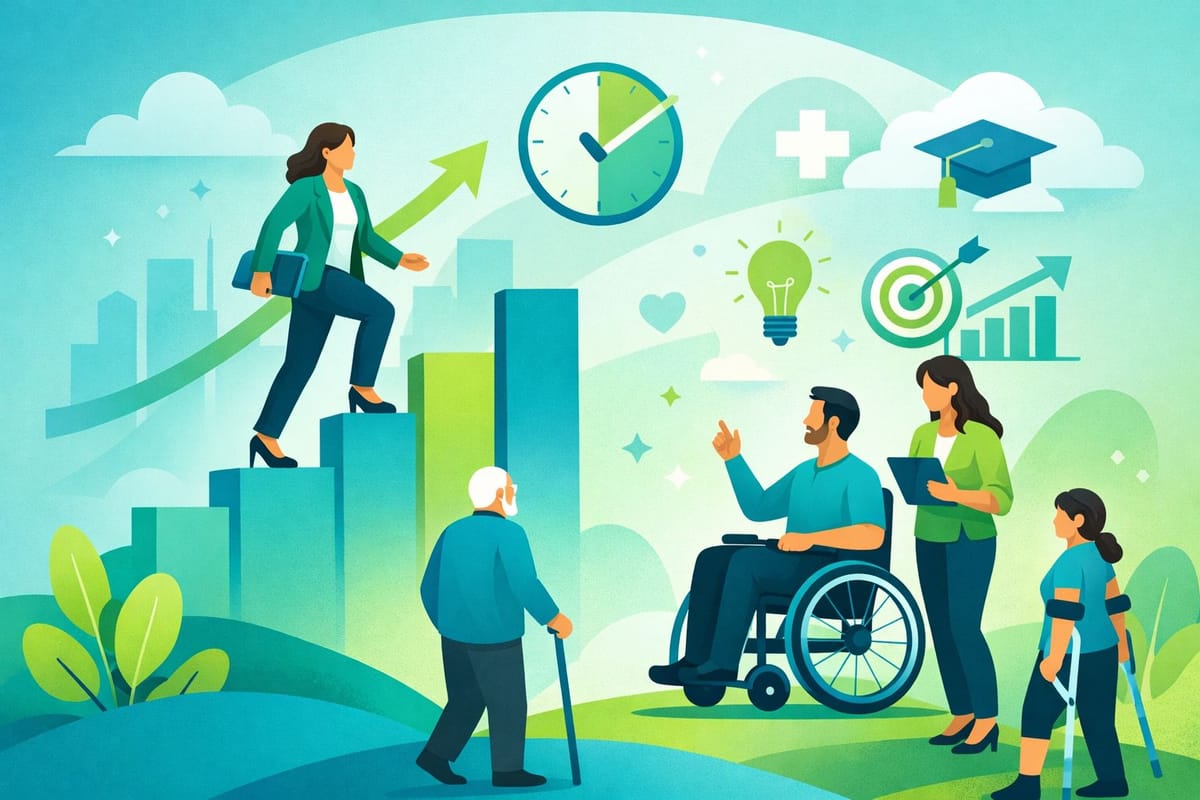
I had a conversation with someone recently and we talked about a career truth that is rarely acknowledged: not everyone has the same amount of time at work.
Professional conversations often assume a linear path: Graduate → entry-level → mid-career → leadership → retirement.
But for many professionals with disabilities, that path doesn’t exist—or starts much later.
Some enter the workforce years after their peers because of:
- Extended medical care, surgeries, or rehabilitation
- Delayed or disrupted education due to health or access barriers
- Years spent simply trying to survive, stabilize, or gain basic independence
By the time many disabled professionals are able to work fully, they’re already behind on the traditional timeline—through no fault of their own.
At the same time, disability can come with a very real awareness that:
- Health can change without warning
- Energy, stamina, or mobility may decline earlier than expected
- Working 40+ years may not be realistic
So when you see a disabled professional intentionally accelerating their career—seeking promotions, leadership opportunities, or broader scope earlier—it’s rarely about ego or impatience.
It’s about urgency shaped by reality.
It’s about asking:
- How do I make meaningful impact while I can?
- How do I reach financial stability sooner to prepare for future medical needs?
- How do I lead and influence while my voice is strongest?
This urgency often produces extraordinary strengths:
- Strategic thinking earlier in careers
- High adaptability and problem-solving skills
- Deep empathy and people leadership
- A strong focus on outcomes rather than optics
Yet too often, these professionals are told they’re “not ready,” “moving too fast,” or “should wait their turn.”
- The problem isn’t readiness.
- The problem is rigid career models that weren’t built with disability in mind.
If organizations want to be serious about disability inclusion, it requires more than accommodations. It requires rethinking how we define:
- Experience
- Readines
- Leadership potential
Equity means recognizing that career paths are shaped by bodies, health, and access—not just ambition.
And when we honor that reality, we don’t just support disabled professionals—we build workplaces that are more human for everyone.