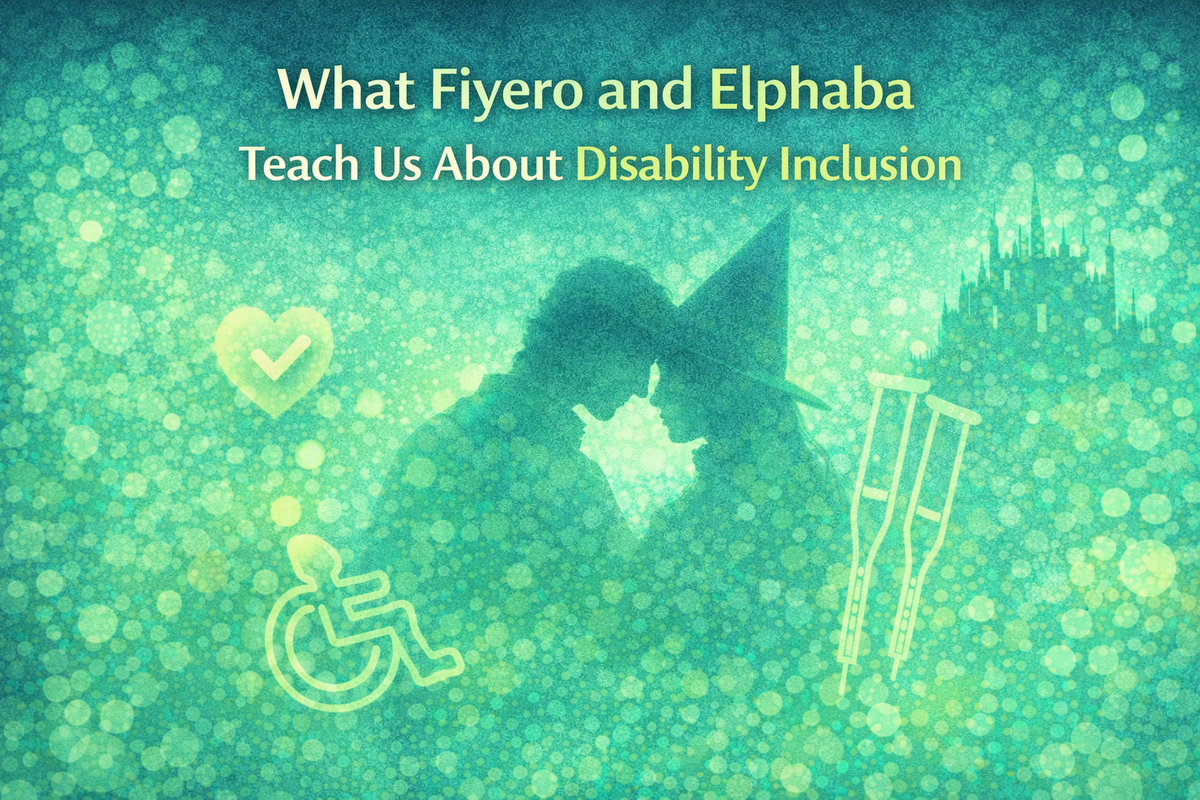
What Fiyero and Elphaba Teach Us About Disability Inclusion
And from the very beginning, the world decides what her story is supposed to be.
I don't know if you've met me, but I'm kind of a huge fan of Wicked – the play, the movies, I love it all and what it stands for. There’s a moment in Wicked where everything shifts — not because the world suddenly becomes kinder, but because two people choose to see each other differently.
Elphaba has always been marked as “other.”
Her difference is visible. Immediate. Unavoidable.
And from the very beginning, the world decides what her story is supposed to be.
Fiyero, on the other hand, starts out skating through life. He benefits from the system without questioning it. He’s charming, liked, and largely untouched by the consequences that shape Elphaba’s experience.
Until he isn’t.
Seeing beyond the narrative
In Wicked, Elphaba is framed as dangerous, difficult, and disruptive — not because she is, but because she challenges power and refuses to assimilate quietly. Her difference becomes a threat.
This mirrors how disability often shows up in workplaces and systems:
- Difference is labeled as “hard”
- Advocacy is seen as “resistance”
- Accommodation is framed as inconvenience rather than design
What makes Fiyero’s evolution so meaningful isn’t that he suddenly becomes a hero — it’s that he unlearns the story he was given.
He stops treating Elphaba as a symbol or a problem to solve and starts listening to her as a person.
That shift matters.
Allyship isn’t loud — it’s loyal
By the time we reach Wicked: For Good, Fiyero’s transformation is complete. He no longer needs applause. He no longer needs approval. He chooses alignment over comfort.
That’s what real allyship looks like.
Not performative support.
Not saviorism.
Not speaking for someone.
But standing with them — even when it costs you something.
In disability inclusion, this is the difference between:
- Policies that look good on paper
- And systems that actually work for people
It’s the difference between checking a box and changing a culture.
Elphaba was never the problem
One of the most powerful truths Wicked offers is this:
Elphaba doesn’t need to be redeemed.
She doesn’t need to be softened, fixed, or made more palatable.
The world around her needs to change.
That truth sits at the heart of disability inclusion. Too often, disabled people are expected to adapt endlessly — to systems that were never designed with them in mind — while being praised for resilience instead of supported through equity.
Elphaba’s story reminds us that difference isn’t a deficit.
It’s information.
It’s perspective.
It’s power — when we choose to honor it.
“For Good” isn’t about endings — it’s about impact
The phrase “for good” isn’t just about permanence. It’s about transformation.
Elphaba and Fiyero don’t change the world because they’re perfect.
They change it because they’re brave enough to choose each other, truth, and justice — repeatedly.
Disability inclusion works the same way.
It’s not a single initiative.
It’s not a training.
It’s not a moment.
It’s a series of choices made for good:
- To listen instead of assume
- To design with, not around
- To stand up when silence is easier
And when we do that — when we choose empathy, allyship, and accountability — we’re all changed.
Not temporarily.
Not performatively.
But for good.